Search This Blog

Sunday, 31 August 2014

Paragraphs

The Paragraph Hamburger

In Year Three we have introduce the 'Paragraph Hamburger' to help the children organise their writing into paragraphs. The 'Hamburger Paragraph' is a visual aide that allows the children to understand the key components needed in a paragraph. As the children write a topic sentence, detail sentences and a closing sentence they form different pieces of a hamburger.
The children in the top writing group are creating videos explaining how to use the structure to help write excellent paragraphs. These will be added to our blog as they are completed.
Blow are the children's reflections on the Hamburger structure.

Children's Blog:

Paragraphs are groups of sentences that tell the reader information about the text.
At school we have been learning about topic sentences, supporting sentences and concluding sentences.
In class we have been using hamburgers to help us organise our paragraphs. The topic sentence is a sentence that tells the reader the main idea of the paragraph. The topic sentence is the top bun. 
The supporting sentences are like the lettuce, tomato, cheese and meat. You should always write the most important information last so it is the meaty part of the paragraph. The bottom bun is the concluding sentence , it is similar to the topic sentence. When you write a concluding sentence you can use the same words you used in the topic sentence.
The first detail is the 'lettuce'. The lettuce comes straight after the topic sentence but is not the most important information. It should be full of good 'lettucy' detail. The second sentence is not the most important sentence, it needs to be full of 'juicy' details. The third sentence is still not the most important sentence. It should be full of good 'cheesy' detail. The last supporting sentence should be the most important piece of detail. It should be full of good 'meaty' detail. Each sentence should have a different sentence starter.
The Hamburger structure can help you write paragraphs correctly.

Can you find the topic sentence in the paragraph from "Harry Potter".

We used the hamburger to write a paragraph about a platypus. 

Year Three Challenge

Write a paragraph using the 'Hamburger Structure'. Label the different sections. Check your spelling and punctuation. Bring your published piece into class and we will added it to our "Absolutely Amazing Authors" board.


Saturday, 23 August 2014

Book Week 2014


Connect to Reading - Reading to Connect

This year's Book Week theme is Connect to Reading - Reading to Connect. According to the 'Children's Book Council of Australia ', "Connect to reading is about enjoying the experience of exploring story, and travelling to other worlds.
The reflected slogan. Reading to connect, has a broader social meaning, suggesting that reading assists in creating a bond with others. Within the world of the contemporary child, this is also relevant as they read books and they read to connect through a variety of media."(According to Children's Book Council of Australia website)

Below are the Year Three's reflections on Book Week

Book Week

This week is Book Week. People are going to dress up as their favourite book character, one they connect with. The infants are invited to enter a colouring in competition but the primary entered a drawing competition. Mrs Taylor (our school librarian) is excited to announce the winners. Maybe they will win a book or a prize that is bigger. (Group -

On Monday  18 August it was the start of Book Week! On Tuesday our whole school dressed up as a book character they connected with because the theme was connect to reading. The parade was held in the Parish Centre in two sessions because it was raining. The second session had a surprise that the parents had to sear not to tell the first session people. What was the surprise???

We saw lots of different characters like Captain Underpants, Cat in the Hat, Iron Man, Thin 1 and Thing 2. Mrs Love dressed up as a witch from 'Room on the Broom'.  We had a great day.

Investigating Australia

Integrated Unit - Australian Emblems

As part of our Integrated Unit on Australia, we have been investigating our National Flora and Fauna. Australia's national floral emblem is the Golden Wattle. It is an evergreen, spreading shrub. When it flowers it displays our countries national colours of green and gold. These colours are often seen during formal occasions or when people are representing our country, such as at the recent Commonwealth Games and the Pan -pacific swimming competition.

The Golden Wattle grows across Australia and is ideally suited too live through our country's droughts, winds an bushfires. The resilience of the wattle is meant to represent the spirit of the Australian people.

Did you know the first day of September is National Wattle Day?  
This day was introduced in 1913 by an association called the Wattle Day League and formally recognised on 23 June 1992. Australians can celebrate their floral heritage by planting wattles. (according to Australian Government - It's An Honour, Australia celebrating Australians)

The children in Year 3 showed their artistic skills as created their own interpretation of the Golden Wattle.

Golden Wattle

Year 3 have been learning about the Australian Emblems, the Floral (Flower) Emblem is the Golden Wattle. The Australian national flower has golden flowers growing out of its stems, called wattles. The golden wattle is the most special flower to Australia. Year Three have completed an art work representing this special flower. We hung them in the Parish entre for our assembly. The parents seemed to like them as many asked if they could take them home, but we wanted to hang them in our classroom.
The golden wattle is Australian because it is found all over Australia, even in our school. The National animals are the kangaroo and the Emu. They are found on our National Emblem.

Here are some of our Golden Wattles:


Sunday, 17 August 2014

Writing


Imaginative Texts

According to the new New South Wales Syllabus by the end of Stage 2 it is expected that the children will  "create well-structured imaginative, informative and persuasive texts in terms of topic, purpose, audience and language by drafting, proofreading and editing for familiar and unfamiliar audiences. They use simple and complex sentences, paragraphing, punctuation and grammatical features characteristic of the various texts to support meaning"


In order for the students to become effective writers, we guide them through a variety of activities that start with high teacher support and lead to experiences that need low teacher support. Throughout the teaching process the students engage in activities that include modelled experiences through to independent writing.

Through out our writing time the children in Year 3 engage in a variety of experiences that help develop their writing skills. 

One such experience of high teacher support is modelled writing.

What is Modelled Writing?

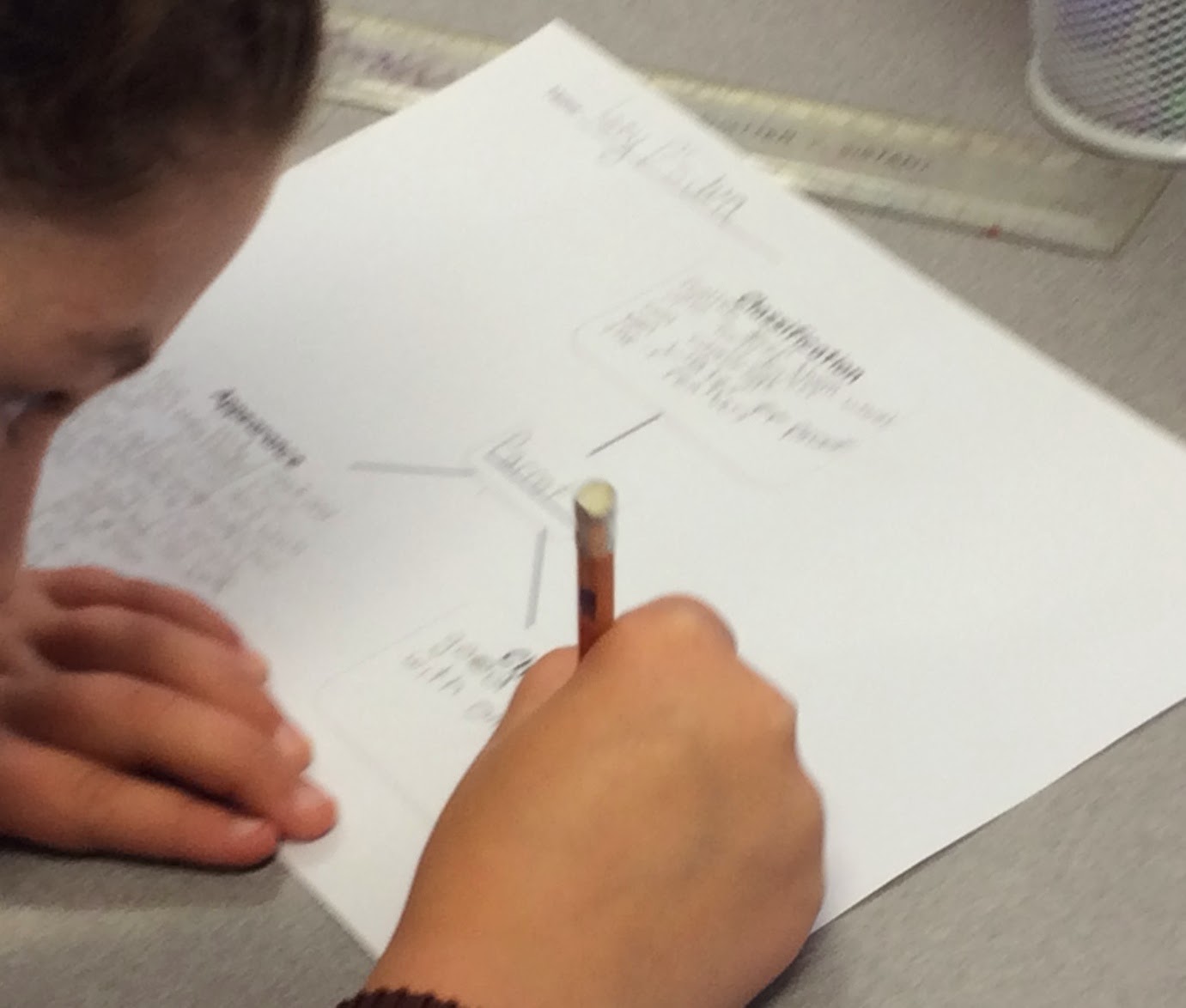
During modelled writing the teacher explicitly models particular aspects of writing, thinking aloud as they model how an expert writer composes, revises, edits and/or proofreads their texts. Last week the Year Three teachers modelled how to organise ideas into a concept map. After the modelled experiences the children were split into three groups and engaged in activities that allowed children to either independently organise their own mind map, construct a mind map with teacher's support or work with peers to organise a mind map based on an Australian animal.

Throughout the week the children have been given the opportunity to reflect on our writing experiences. Their insights are found below.


Descriptions

Year Three have been focusing on descriptions. We have been writing, reading and talking about descriptions. After recess everyday our teachers do a 'Read-A-Loud' with us. This term we are reading Harry Potter, and it is full of descriptions. We love Harry Potter. It is the best book, although we have only read a few chapters. Mrs Standring read a great description of Dumbledore - "he is tall, thin and very old judging by the silver of his hair and beard, which were both long enough to tuck in his belt. he was wearing long robes with a purple cloak that swept the ground ..."
She turned this into an art activities and helped us use our imagination and art skills and draw Dumbledore.
Last week the teachers showed us how we can use a mind map when planning out work. We have all chosen an Australian animal to research and write a description about. As a class we are writing one on a bilby. The teacher's will be writing a description on the bilby while we chose one of the following animals, emu, cassowary, dingo, wombat, koala, echidna, salt water crocodile, platypus or parrot.
Mind Maps are a good way to organise your ideas. Next week we will be using our mind maps to write sentences and paragraphs. 

Challenge

Create a mind map on your favourite animal. Your headings could include: Classification (Is it a mammal, marsupial, reptile, monotreme, shark) Description (face, body, limbs) characteristics (nocturnal, omnivore, carnivore, hunter, scavenger) Send them in and we will hang them in our space so others can see how to use mind maps. 

Our drawings of Dumbledore


Mind Maps help us organise our thoughts . We can use these to write descriptions.


Sunday, 3 August 2014

Creation Stories

The Story of Creation

During our Religion unit on God's Wonderous Creation, Year Three read and discussed the story of creation. In our cooperative learning groups we read the biblical passage and discussed words we did not understand. Then each group was given one of the days of creation. In our groups we discussed the main ideas for our day and together designed and made moveable parts. Then we a Stop Motion App to create these animations based on Genesis 1:1-31, 2:1-4

Blog Challenge:

Make you own animation based on a Scripture story. Maybe you could choose one of the parables we looked at during Reconciliation preparation. If you have an ipad you can use the Stop Motion App. Animations can also be made using pages in a book, investigate how you can make it work. We would love to see your finished product.

Monday, 21 July 2014

Mathematics

During Stage 2 the children develop their understanding of three dimensional shapes. Our lessons involve the children making models of three-dimensional objects and describe their key features. This week the children are investigating, making and identifying the variety of nets that can be used to create prisms.
The task is included below:

Task:

Imagine a rectangular prism. How many nets can you make of the same
 rectangular prism?
 Would it make a difference if you used a special rectangular prism
like a cube?

To help the children engage in their learning we deliberately discuss with the children the Learning intention of the lesson and together set up a success criteria. The success criteria allows the children to receive immediate feedback and gives them direction on what they need to do to successfully unpack the task. It is important for the children to be challenged by the task and not just roaming the known, which means ding work they already know.Throughout the week the success criteria is added to so the children are continually encouraged to build on their learning.

Learning Intent:

Three-dimensional shapes have faces that show a two dimensional shape. Nets are three-dimensional shapes flattened out. The same three-dimensional shape can have more than one net.
Success Criteria:
  • I can sketch a net.
  • I can find more than one net for the same shape.
  • I can check my answer by refolding my net to form the original shape
  • I can … 

http://www.benscoloringpages.com/coloringpages/cubenet.jpg
An example of a net for a cube

Children's Reflections

Last week we started to investigate three- dimensional shapes. We went on a hunt and Patrick took lots of photos.


Term Three

Week one through the Eyes of the children

In Year Three, Term 3 will be full of great learning reflections that you will be able to read through in our blog. Every day the children are given a topic to write about and spend time in their cooperative groups organising their thoughts and taking photos to enhance their reflections.

Below you will find last weeks blogs. Enjoy!

New Boy


On the first day of term 3, 2014 we welcomed a new boy, named Samuel. He is in 3V. He speaks a little bit of English but is enjoying teaching us his native language - Slovakian. Samuel is visiting us for a month. He is very smart, well behaved and so far has taught us to say Goodbye in Slovakian.

Australian Animals

Now that we are in Term 3 we are learning about Australian Animals. In our Integrated books we have started a title page about Australian Animals. A few of the Australian animals are extinct and some are very rare. Some of the animals are dingoes, kangaroo, wombat but their are some other ones we haven't even heard about yet. Some live on land and some live live in the sea near Australia.
These are the names of some of the mammals that live in the water; platypus, dolphins and whales.

Do you know any collective nouns used for animals? Send them in and we will add them to our list.
Mob of kangaroos
Parliament of owls
Murder of of crows